Pardon My Planet
Pardon My Planet is a podcast from LGI Sustainable Innovation that highlights innovative, ambitious and sustainable projects across Europe and beyond. Through interviews and speeches, experts share insights on topics such as nuclear energy, the circular economy, and energy transitions. The show aims to showcase practical solutions and forward-looking initiatives. More information is available at lgi.earth/podcast.
Épisodes
Episode 3 (FR): La pollution des sols en Europe: menaces et solutions
Invités : Virginie Derycke, ingénieure géochimiste, experte en sites et sols pollués au BRGM, le service géologique national, et Michel Chalot, professeur à l'université Marie et Louis Pasteur et chercheur spécialisé dans le développement des solutions basées sur la nature.Dans cet épisode, nous nous penchons sur l'une des menaces les plus pressantes, et souvent invisibles, qui pèsent sur nos sols
Episode 3 (EN) - Polluted soils in Europe: Challenges and solutions
Guests: Virginie Derycke, geochemical engineer and expert in contaminated sites and soils at BRGM, the French geological survey, and Michel Chalot, professor at the Université Marie et Louis Pasteur and researcher specialising in the development of nature-based solutions.In this episode, we turn to one of the most pressing and often invisible threats to our soils: pollution. Soil contamination aff
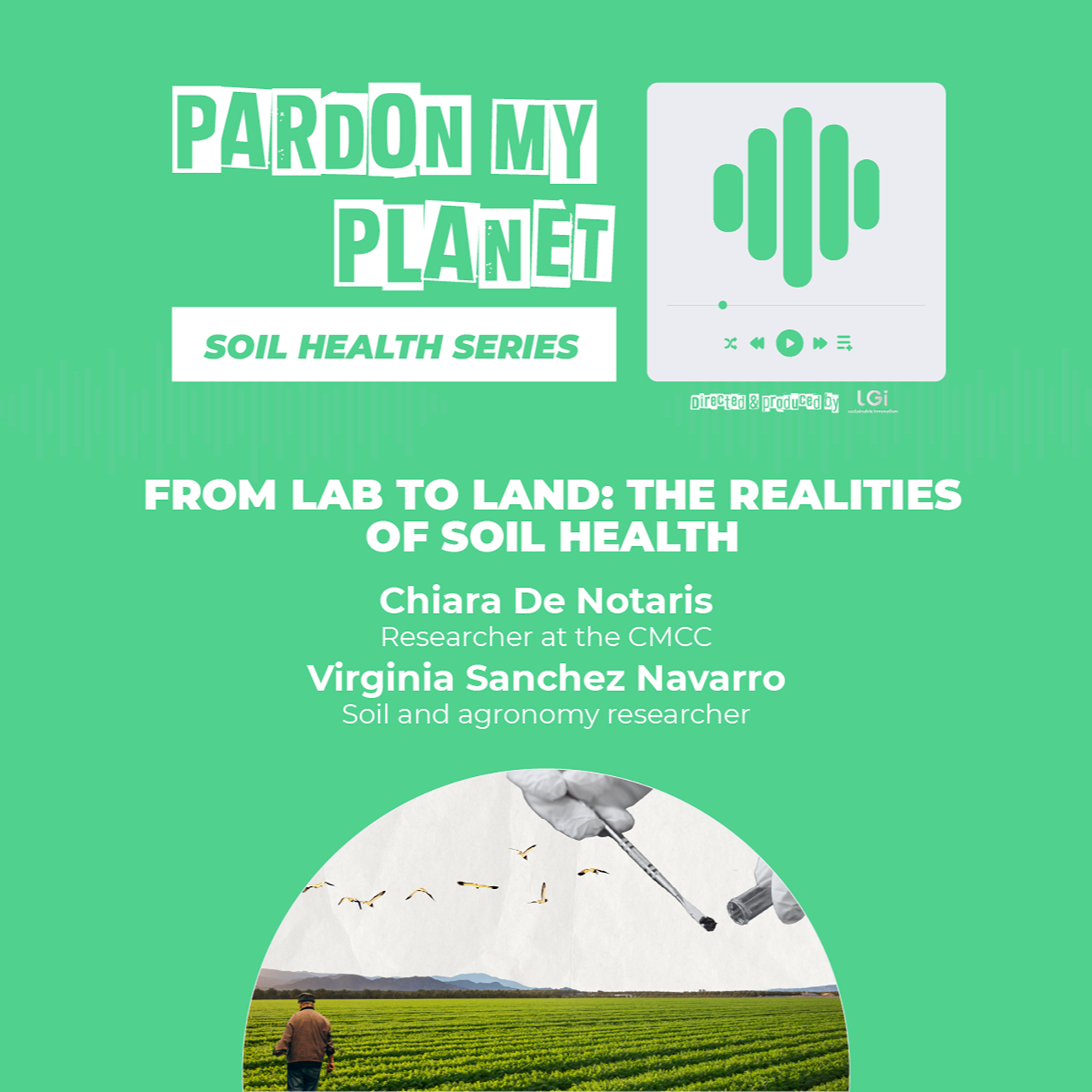
Episode 2: From lab to land: the realities of soil health
In this episode, we focus on what happens once knowledge about soils leaves research papers and experimental plots and begins to shape real-world decisions, from farming practices to risk assessment and policy. The conversation explores how scientific understanding translates into action, where gaps and tensions emerge along the way, and what helps bridge science, practice, and decision-making.The
Episode 1: The invisible foundation of our ecosystem
This episode aims to set the foundations of the series by exploring what soil really is: a living, complex, and fragile ecosystem that underpins our food systems, climate regulation, and biodiversity. Together, we will unpack why soil health matters today, why it is under pressure in Europe, and how science and policy are beginning to respond.
Développer la chaîne de valeur des minéraux en Afrique
Invitée : Marit Kitaw, économiste du secteur minier à la Commission Économique pour l’Afrique (CEA)Le podcast Pardon My Planet présente sa première série en français, consacrée aux partenariats entre l’Afrique et l’Europe autour des matières premières critiques. À travers trois épisodes, cette série explore les enjeux de souveraineté, d’inclusion, et de développement durable dans le secteur minier
L'exploitation minière artisanale et l'inclusion des femmes
Invitées : Pascaline Balbine Makani, présidente de l’Association des femmes du secteur minier du Cameroun, et Rosine Atafeinam Abalo, présidente de l’Association des femmes du secteur minier et en entreprise du Togo, et vice-présidente d’AWIMA (African Women in Mining Association)Le podcast Pardon My Planet présente sa première série en français, consacrée aux partenariats entre l’Afrique et l’Eur
Les minéraux critiques, pourquoi et pour qui?
Invitée : Lika Scott Sow, fondatrice de Women in Mining Sénégal et membre d’AWIMA (African Women in Mining Association)Le podcast Pardon My Planet présente sa première série en français, consacrée aux partenariats entre l’Afrique et l’Europe autour des matières premières critiques. À travers trois épisodes, cette série explore les enjeux de souveraineté, d’inclusion, et de développement durable da
Fostering responsible extraction in the Artisanal and Small-Scale Mining sector
This episode is part of our series Bridging Continents: The Africa-Europe Partnerships for Critical Raw Materials. In this episode of Pardon My Planet, we turn the spotlight on Artisanal and Small-Scale Mining (ASM) in Africa, a sector that provides millions of jobs but still operates largely informally and faces significant challenges.We explore a training programme held in Zimbabwe, part of broa
From mineral exploration to sustainable mining: the future of critical raw materials
Mining often conjures up negative imagery: environmental damage, pollution, and disruption to local communities. Yet, as we’ve explored in previous episodes of Pardon My Planet, critical raw materials are essential to modern life. They power solar panels and wind turbines, are at the core of smartphones and electric vehicles, and even play a crucial role in medical technologies, from MRI machines

Transforming recycling for a sustainable textile industry
The fashion industry has a huge impact on our planet, from the waste it generates to the resources it consumes. Fortunately, change is happening. Recycling, innovation, and collaboration across the supply chain are key to transforming the way we produce, manage textiles. Today our guest is Jyotsna Gopinath, innovation analyst at Fashion For Good, a global initiative dedicated to transforming the f

How to finance CRM projects in Africa
This last episode of the AfricaMaVal series illustrate the tangible impact AfricaMaVal can have through the selection of 100 project opportunities.
Introduction to the AfricaMaVal project
The introduction episode features the project coordinator and offers an overview of the series and the key issues at hand.
Geopolitics in critical minerals in africa
This episode provides us with essential background information on the geopolitics of critical minerals and highlight the importance of the EU developing partnerships with resource-rich countries.
ESG conditions and women in mining in Africa
This episode is focusing on ESG conditions along the CRM value chain in Africa, placing special emphasis on women in mining in Africa.

Adapting to climate challenges: insights from Mozambique's farmers
In this episode of Pardon My Planet, we explore how climate services, genetic research, and collaboration with local farmers are helping communities in Mozambique adapt to climate change.Our guests, Valentina D’Amico, a socio-economic researcher, and Marta Da Graca Eugenio Solemanegy, a Mozambican PhD student specialising in agronomy and genetics, share their on-the-ground experiences. They discus
From crisis to innovation: Exploring renewable solutions with LEAP-RE
We are joined by Sigfried Tivana, assistant director at the Department of Science and Innovation in South Africa and co-coordinator of LEAP-RE. Sigfried discusses the pressing energy challenges facing South Africa, from access issues to the sustainability of current energy practices. He also shares the challenges of piloting such a large program as LEAP-RE and what the future holds for this initia
Quality & equity in electricity access across Africa
This episode explores the critical issues of sustainability and equity in electricity access. Marine Cornelis, an expert in energy policy and public affairs, discusses her work on the EURICA project in Madagascar and Burkina Faso, two regions facing significant yet different energy challenges. Marine’s insights into the practicalities of providing quality electricity access offer a sobering look a
Empowering women with Africa's renewable energy
In this episode, we shift our focus to Kenya, where Anne Wacera Wambugu, an electrical engineer and researcher at Strathmore University in Nairobi, discusses the current state of renewable energy development and its future prospects. Anne sheds light on the pressing issue of electricity quality and equipment disparities, particularly in solar energy production, and highlights the need to empower w
Introduction to renewable energy in Africa
In the opening episode of our series, Leonard Lévêque, project manager at LGI and co-coordinator of LEAP-RE, provides an overview of the renewable energy landscape across the African Union. Leonard emphasises the crucial importance of developing renewable energy sources in Africa, not just to meet growing energy demands, but as a pivotal strategy for sustainable development.More information on: lg

The Principles of Circular Economy
Nearly 110 billion tons. This is the amount of material extracted from Earth in 2024 alone, according to the Global Resources Outlook by the United Nations Environment Program. The stark increase from approximately 30 billion tons in 1970 underlines the accelerating pace of global consumption.A circular economy is vital for a sustainable future. It challenges the traditional, linear "take-make-was

Urban Forests & Nature-based Solutions
According to a report by the United Nations, it is said that 70% of the world population will live in urban areas by 2050. And with the expansion of urbanised spaces comes the challenge of not only protecting but also reintroducing nature in cities. Where do we find enough funding and do we convince investors that it is the future of cities?Pierre Cattoire, Sustainable Innovation Strategist at LGI

What are Advanced Biofuels?
In this episode, we delve into the world of advanced biofuels! Today, we spotlight an innovative European project called BL2F, which is pioneering a technology to produce sustainable fuel for transport, including aviation and maritime sectors, from an unexpected source: black liquor. Joining us for this enlightening discussion is Adéola Jaiyeola, Sustainable Innovation Analyst at LGI, who wil
Recommandé

Les Aventures d'Ulysse

Le Bureau de l'étrange - ( HISTOIRES D'HORREUR - CREEPYPASTAS - HISTOIRES AUDIOS)

Histoires de lieux hantés

ΦΙΛΟΣΟΦΙΑ - Amour de la sagesse - L'histoire de la philosophie

Ondes sociales

Aprende Francés con Claudia En Francia

Interlude Hip-Hop Classics

C'est bon à savoir

L'antre de la peur

Les Nouilles Rampantes
La Station Hantée

ITMPROD en Mix Live set dj-Radio
